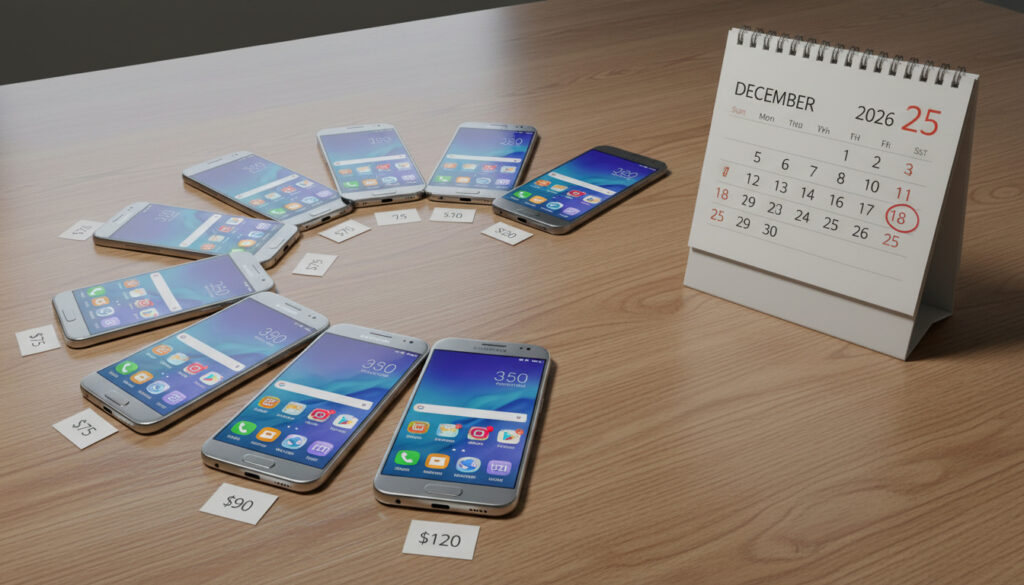
Galaxy J Series to Buy – Best Used Models 2026
Samsung’s Galaxy J series defined the budget smartphone segment between 2015 and 2018, bringing 4G connectivity to emerging markets through affordable hardware featuring expandable storage and dual-SIM capabilities. These devices prioritized essential functionality over flagship features, establishing Samsung’s presence in the entry-level market before the era of universal 5G adoption.
Today, the entire lineup stands discontinued, with Samsung redirecting all manufacturing resources toward the Galaxy A series. Buyers encountering these phones in 2026 face a used-only market where battery degradation and obsolete software present significant challenges. Understanding which models remain functional versus those destined for immediate obsolescence requires careful evaluation of hardware specifications against modern application demands.
Which Galaxy J Series Phone Should I Buy?
1080p display, 3-4GB RAM, Android 10 support
₹7,500
6″ IPS display, 3300 mAh battery, expandable storage
₹7,000
Dual 13+5MP rear, 16MP front, Helio P20 processor
₹24,000
5.6″ Super AMOLED, 4GB/64GB configuration
₹10,000
- All J series production ceased in 2018; only used and refurbished units circulate today.
- J7 Prime and J7 Duo offer optimal balance with 1080p displays and 3-4GB RAM.
- J1, J2, and J4 Core variants provide inadequate performance with only 1GB RAM.
- Used pricing ranges from ₹5,499 for entry models to ₹28,000 for premium variants.
- Battery replacement is often necessary due to age-related degradation.
- Final Android versions vary between Android 8 and 10 depending on model year.
- Galaxy A series devices deliver superior specifications at comparable secondary market prices.
| Model | Year | Processor | RAM | Display | Camera | Battery | Price (2026) |
|---|---|---|---|---|---|---|---|
| Galaxy J1 4G | 2015 | Spreadtrum SC7727S | 1GB | 4.5″ 480×800 | 5MP/2MP | 2050 mAh | ₹5,499 |
| Galaxy J2 Pro | 2018 | Snapdragon 425 | 1.5-2GB | 5″ Super AMOLED | 8MP/5MP | 2600 mAh | ₹6,000 |
| Galaxy J4+ | 2018 | Snapdragon 425 | 2-3GB | 6″ IPS 720p | 13MP/5MP | 3300 mAh | ₹6,999 |
| Galaxy J6 | 2018 | Exynos 7870 | 4GB | 5.6″ 720p | 13MP/8MP | 3000 mAh | ₹9,999 |
| Galaxy J7 Prime | 2016 | Exynos 7870 | 3GB | 5.5″ 1080p | 13MP/8MP | 3300 mAh | ₹7,499 |
| Galaxy J7 Pro | 2017 | Exynos 7870 | 3GB | 5.5″ 1080p | 13MP/13MP | 3600 mAh | ₹9,990 |
| Galaxy J7+ | 2017 | Helio P20 | 4GB | 5.5″ Super AMOLED | 13+5MP/16MP | 3000 mAh | ₹23,990 |
| Galaxy J8 | 2018 | Exynos 7870 | 4GB | 6″ Super AMOLED | 16+5MP/16MP | 3500 mAh | ₹15,000 |
Is the Galaxy J Series Still Available?
Samsung officially discontinued the J series in 2018, redirecting manufacturing resources toward the Galaxy A and M series. No authorized retailers stock new units, limiting acquisition to secondary markets and individual sellers. Market analysis confirms zero official distribution channels remain operational for this product line.
Battery degradation affects nearly all available units due to age and storage conditions. Most devices launched with Android 6-8 and cannot upgrade beyond Android 10, leaving security vulnerabilities unpatched since 2020. Verify seller warranty terms and physical condition before purchasing, as replacement components grow increasingly scarce.
Navigating the Used Market
Secondary markets in India price units between ₹5,000 and ₹28,000 depending on model tier and physical condition. Online classifieds and local electronics bazaars remain primary channels, though authenticity verification presents risks without original packaging or purchase receipts. International buyers should expect pricing between $50-300 USD globally, contingent upon regional availability and import restrictions.
The Galaxy Jump 4 Question
Rumors circulate regarding a “Galaxy Jump 4″ listing specifications including Android 15, 5G connectivity, and a 6.7” 120Hz display at ₹27,990. Documentation indicates this represents either a naming coincidence or regional variant unconnected to the original J series lineage, rather than a genuine revival of the discontinued lineup. Samsung has confirmed no plans to resurrect the J branding.
Galaxy J Series Specs and Prices
Specification sheets reveal significant generational gaps between early and late J series entries. Processors range from the underpowered Spreadtrum SC7727S in 2015’s J1 to the Helio P20 in 2017’s J7+, creating vastly different user experiences across the family. Display technology evolved from basic LCD panels to Super AMOLED implementations in later models.
Specific chipsets and RAM configurations vary by market. Indian variants often featured Exynos processors, while some international versions shipped with Snapdragon alternatives. Always confirm exact model numbers (e.g., J710F versus J710M) before comparing specifications, as hardware capabilities diverge significantly between regional SKUs.
Entry-Level Constraints
The J1 4G, J2 Pro, and J4 Core target ultra-budget buyers with 1-1.5GB RAM and 8-16GB internal storage. These specifications struggle with contemporary applications, experiencing frequent lag and aggressive background app terminations. Displays measure 4.5 to 5 inches at sub-720p resolutions, appearing dated compared to modern entry-level standards.
Mid-Range Practicality
J4+ and J6 models introduced 6-inch IPS and 5.6-inch Super AMOLED displays respectively, paired with 2-4GB RAM. The J6 specifically offers adequate performance for media consumption with its 64GB storage variant, though the Exynos 7870 processor shows age when handling simultaneous application processes or high-bitrate streaming.
Premium J Series Performance
J7 variants represent the lineup’s technical peak. Samsung’s documentation positions the J7 Prime as the series turning point, introducing 1080p resolution and 3GB RAM in 2016. The J7+ added dual-camera arrays and 4GB RAM, while the J7 Pro features a substantial 3600 mAh battery providing superior longevity compared to siblings.
Is Galaxy J Series Worth Buying in 2024?
Contemporary application requirements have outpaced J series hardware capabilities. While basic calling and messaging functions remain viable, modern social media platforms and security demands exceed the processing power and operating system support available on these devices. No professional reviews address J series performance in current contexts, with coverage having shifted entirely to the A series.
Consider the Galaxy A14 or A24 instead of J series units. These newer models offer 5G connectivity, four-year security updates, and cameras with night mode for roughly ₹10,000-₹15,000—comparable to used J8 prices but with modern software support and reliable battery life.
The Performance Reality
Processors in the J series operate at 1.3-2.4 GHz across quad and octa-core configurations. While sufficient for 2018 applications, current software optimizations assume newer instruction sets and additional RAM. Technical comparisons note that while original J series devices featured competitive pixel density at 441 ppi, the aging Android distribution and limited processing overhead create functional bottlenecks for modern multitasking.
Security and Software Limitations
Samsung terminated security updates for most J series devices by 2020. Market analysis confirms attention has shifted entirely to supported product lines. Android versions cap between 8.1 and 10 depending on model, lacking patches for contemporary vulnerabilities. Banking applications and secure services may refuse installation or functionality on these outdated platforms, limiting practical utility for financial transactions.
Galaxy J Series Development Timeline
-
2015: Samsung launches the J series with the J1, J2, and J5, targeting first-time smartphone buyers in emerging markets with entry-level 4G connectivity.
— Wikipedia -
2016: The J7 Prime debuts with a 5.5-inch 1080p display and Exynos 7870 processor, establishing the lineup’s premium tier and shifting expectations for budget displays.
— Smartprix -
2017: Samsung releases the J7 Pro and J7+, introducing dual-camera systems and improved front-facing sensors specifically for the Asian market.
— Wikipedia -
2018: Final major releases include the J4, J6, and J8, featuring upgraded Super AMOLED displays and Android 8.0 baseline before production cessation.
— Smartprix -
2019: Samsung officially discontinues the J series, consolidating budget offerings under the Galaxy A branding and ending software support commitments.
— Samsung
Established Facts and Unresolved Questions Regarding Availability
| Confirmed Information | Uncertain or Unverified Claims |
|---|---|
| Production ended completely in 2018; no manufacturing continues | Rumored “Galaxy Jump 4” represents a potential revival (unconfirmed by Samsung) |
| Used pricing ranges ₹5,000-₹28,000 in Indian secondary markets | Long-term battery stability for devices stored since original manufacture |
| Android support caps at version 10 for J7 Duo and latest variants | Availability of authentic replacement parts outside authorized service centers |
| Galaxy A series officially replaces J series market positioning | Exact production numbers and regional distribution figures by country |
| All units now sold as used or refurbished only | Specific longevity of sealed batteries after six to eight years of storage |
The Market Context Behind J Series Discontinuation
Samsung’s strategic shift reflected changing smartphone economics. The J series operated on thin margins with limited software update commitments, while competitors offered superior specifications at similar price points. The Galaxy A series emerged as a unified solution spanning budget to mid-range tiers, eliminating the fragmentation between J, C, and On series lineups that confused consumers.
This consolidation allowed Samsung to streamline manufacturing and provide longer update cycles—four to five years versus the J series’ typical two-year support. The move aligned with growing consumer expectations regarding security patches and camera capabilities. Current A series devices feature 90-120Hz AMOLED displays and 5G connectivity, specifications that render J series hardware functionally obsolete for demanding users.
For those seeking hardware store near me alternatives for device repair, local shops may struggle to source authentic J series components as official support channels close and third-party manufacturers shift to producing parts for supported models.
Expert and User Perspectives on J Series Hardware
“The J7 Prime’s 1080p display offered exceptional value in 2016, but the 3300 mAh battery and Exynos 7870 processor struggle with modern application demands. Heating issues and bloatware remain common complaints across the series.”
— aggregated user feedback via Technical review analysis
“While the original Galaxy J featured competitive pixel density at 441 ppi and 4K video capability, the 146g weight and aging Android distribution limit practical usability in current security-conscious environments.”
— Versus.com technical comparison
Final Assessment: Should You Purchase a Galaxy J Series Phone?
The Galaxy J series serves only the most basic connectivity needs in 2026. Buyers prioritizing calls, SMS, and occasional web browsing may find value in the J7 Prime or J7 Duo at ₹7,500-₹10,000 price points. However, anyone requiring secure banking applications, modern camera features, or guaranteed software updates should redirect their search toward the Galaxy A14 or A24. With pound to euro forecast fluctuations affecting import pricing, regional availability of newer alternatives may vary, making local A series options more economically sensible than imported J series relics.
Frequently Asked Questions
Galaxy J4 vs J6 vs J8: which offers better value in 2024?
The J6 provides the best balance with 4GB RAM and Super AMOLED display at around ₹10,000. The J4+ offers larger screen size but inferior panel quality. The J8 commands premium pricing without proportional specification gains over the J7 series.
Is the Galaxy J series good for budget buyers today?
Only for ultra-basic needs. At ₹7,000-₹10,000, used J7 models provide calling and messaging functionality. However, modern A series phones offer superior longevity and security for marginally higher investment.
Should I choose Galaxy J or A series?
Choose Galaxy A. The A series offers 5G, modern processors, and four-year software support. J series devices lack security updates and struggle with current applications.
What are the main pros and cons of J series phones?
Pros: Low used prices, expandable storage, reliable construction, adequate battery. Cons: No security updates, outdated Android, insufficient RAM for modern apps, unavailable new.
How much should I pay for a used Galaxy J7?
J7 Prime or J7 Pro units in good condition typically sell for ₹7,500-₹10,000. J7+ models command ₹20,000+ due to rarity. Verify battery health before purchasing.
More related posts
 Erica Stoll: Biography, Job, Net Worth, and Marriage
 Maya Angelou: Biography, Quotes, Poems, Civil Rights Legacy
 Sean Combs: The Reckoning: Verified Facts and Key Details
 India vs New Zealand 2026: Watch, Schedule & Free Streaming
 Ryanair Cabin Baggage Allowance Changes 2026: New Size Rules & Guide
 John Wick 5 Confirmed 2028 – Release Date and Updates
 Things to Do Today – Top Events Near Plainfield IL
 FC Kairat Almaty vs Celtic F.C. Timeline – Head-to-Head Record and Results