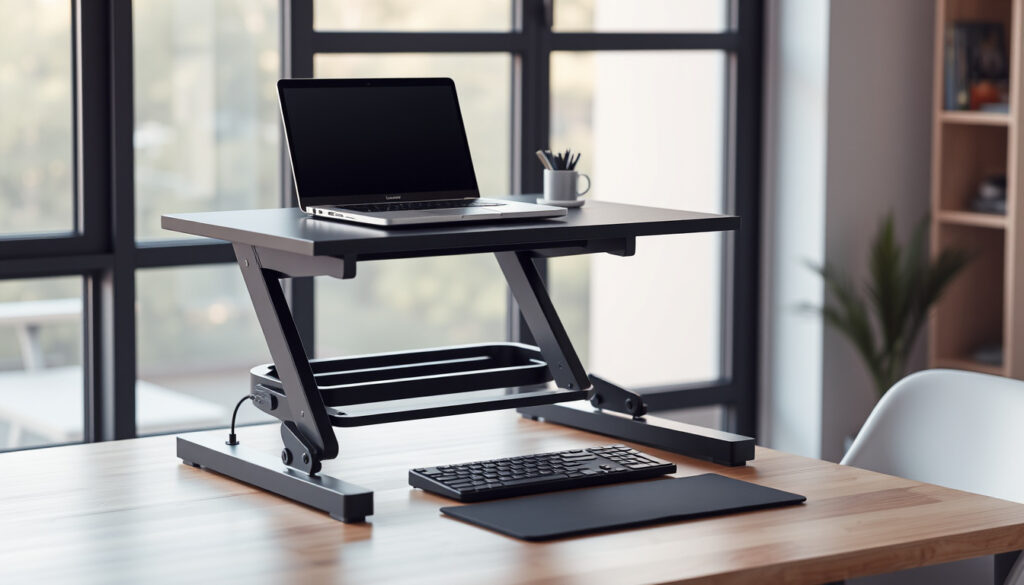
What Is a Riser Desk? Types, Benefits, and Key Comparisons
You have probably spent more hours than you can count glued to a desk chair, and your lower back has likely sent a few subtle signals—but desk risers offer a low-cost alternative to swapping out your entire workspace, with research showing they can shave up to 66% off your daily sitting time. This shift has real metabolic implications.
Reduce sitting time by: up to 66% (2023 study) ·
Average weight capacity: 35 lbs (16 kg) for dual-monitor models ·
Height adjustment range: 4 to 20 inches ·
U.S. office workers using sit-stand solutions: over 25% (U.S. Centers for Disease Control and Prevention (CDC))
Quick snapshot
- Desk risers are effective at reducing prolonged sitting (CDC).
- Calorie burn difference between standing and sitting over short periods is negligible (Harvard Health Publishing).
- Optimal sit-stand ratio for long-term health outcomes isn’t established.
- Productivity impact in remote work settings remains anecdotal.
- Adoption of sit-stand solutions among U.S. office workers rose from ~10% in 2015 to over 25% in 2023 (CDC).
- Expect more affordable electric models with programmable presets as the category grows.
Here are the essential specs at a glance.
| Attribute | Value |
|---|---|
| Product category | Desk riser / standing desk converter |
| Average price range | $80 – $500 |
| Weight capacity | 25 – 50 lbs (11 – 23 kg) |
| Height adjustment type | Gas lift, electric, or manual |
| Common monitor support | Single or dual monitors up to 32 inches |
What is the point of a desk riser?
The purpose is straightforward: a desk riser lets you alternate between sitting and standing while keeping your existing desk. Instead of replacing your entire workstation, you place a height-adjustable platform on top of it—raising your monitor, keyboard, and mouse to standing height.
Key benefit: reduces prolonged sitting
- A 2023 study in the International Journal of Environmental Research and Public Health found that desk risers cut daily sitting time by up to 66%.
- The CDC links prolonged sitting to increased risk of metabolic disease, making any reduction beneficial.
For the average office worker who sits 8+ hours a day, cutting even two hours of that time can lower blood sugar spikes and improve circulation—without buying a new desk.
Ergonomic improvements for neck and back
- Raising the monitor to eye level reduces forward head posture, a common cause of neck strain.
- Alternating positions prevents the static loading that leads to lower back pain.
The implication: a desk riser addresses the root cause of many desk-related aches—prolonged static posture—with minimal disruption to your existing setup.
What is a riser desk called?
You will hear several names, but they all refer to the same product category.
Common names: standing desk converter, desktop riser, sit-stand workstation
- According to Progressive Desk (ergonomic furniture manufacturer), the terms “riser desk,” “desk riser,” and “standing desk converter” are used interchangeably.
- “Desktop riser” is another synonym, especially in UK markets (The Safety Elf, a UK ergonomics consultancy).
Trade names: VariDesk, Ergotron WorkFit
The pattern: the naming confusion is a marketing artefact—buyers should focus on mechanism and weight capacity, not the label.
How does a rising desk work?
The mechanics are simpler than most people assume.
Mechanism: gas lift or electric motor
- Gas-lift models use compressed nitrogen. A lever releases the gas, allowing the platform to rise; pushing down compresses it again (Progressive Desk).
- Electric models use a motor with push-button controls, and some include programmable height presets (Eureka Ergonomic, ergonomic workstation specialist).
Typical adjustment range: 4 to 20 inches
- Most desktop risers lift from roughly 4 inches (sitting height) to 20 inches above the desk surface, accommodating users from 5′ to 6’5″.
- Manual or crank risers provide precise control but are slower (Progressive Desk).
What this means: the choice between gas lift and electric boils down to budget and expected daily adjustments. Gas lift is fine for occasional changes; electric suits frequent alternators.
What are the different types of desk risers?
Three main mechanisms dominate the market, each with distinct trade-offs in cost, load capacity, and ease of use.
Manual gas-lift risers
- Cheapest option, typically $80–$200.
- Weight capacity: 25–35 lbs (Progressive Desk).
- Easiest to install—no tools required.
Electric height-adjustable risers
- Mid-range to premium ($200–$500).
- Weight capacity up to 50 lbs (Eureka Ergonomic).
- Memory presets for quick position changes.
Fixed-height desk risers
- No moving parts—you manually reposition the platform.
- Least expensive but least convenient.
One pattern emerges from the specs: the more you adjust, the more you benefit from electric. For users who stand only once or twice a day, gas lift offers the best value.
Four key specifications, one pattern: weight capacity, height range, mechanism type, and price form a clear ladder from budget to premium.
| Type | Mechanism | Weight capacity | Height range | Price range |
|---|---|---|---|---|
| Gas-lift manual | Gas spring | 25–35 lbs | 4–18 inches | $80–$200 |
| Electric | Motor | 35–50 lbs | 4–20 inches | $200–$500 |
| Fixed height | None | up to 40 lbs | fixed | $50–$100 |
This table summarises the key differences between budget and premium options.
Desk riser vs. standing desk: which suits you?
The choice depends on your budget, space, and how often you switch positions.
This comparison highlights the key trade-offs.
| Feature | Desk riser | Full standing desk |
|---|---|---|
| Cost | $80–$500 | $300–$1,500+ |
| Installation | Minimal; sits on existing desk | Requires assembly; replaces desk |
| Stability at height | Moderate; may wobble with heavy monitors | High; engineered base (Eureka Ergonomic) |
| Desktop space | Reduces usable surface (Tribesigns) | Full surface remains usable |
| Portability | Easy to move or remove (Tribesigns) | Heavy, semi-permanent |
| Flexibility | Sit-stand without replacing furniture (Tribesigns) | Full desk height adjustable |
A desk riser is 2–5× cheaper and instantly deployable, but it eats into your work surface and may feel less solid at standing height. Full standing desks win on stability and space at the cost of price and effort.
The decision ultimately depends on your budget and space constraints.
Is standing for 2 hours good for you?
The short answer: yes, but only if you alternate.
Health benefits of intermittent standing
- Harvard Health Publishing notes that standing burns about 0.7 more calories per minute than sitting—not enough for weight loss, but enough to reduce metabolic risk.
- The CDC Physical Activity Guidelines recommend breaking up sitting with standing every 30–60 minutes.
Research on optimal sit-stand ratios
- A 2023 analysis suggested a 1:1 sit-stand ratio (30 minutes each) for beginners, increasing to 2:3 after two weeks.
- Standing for 2 hours consecutively can strain the lower back if you are unaccustomed (Eureka Ergonomic).
The catch: no single ratio is proven superior—your body’s feedback is the best guide.
Upsides and downsides of desk risers
Upsides
- Low cost compared to full standing desk (Uncaged Ergonomics)
- Easy installation and portability (Tribesigns)
- Reduces sedentary time (CDC)
- No need to replace existing furniture (Tribesigns)
Downsides
- Reduces available desktop space (Tribesigns)
- Less stable than engineered standing desks (Eureka Ergonomic)
- Limited weight capacity (usually ≤ 50 lbs)
In short, desk risers offer a cost-effective way to reduce sitting time, but they come with trade-offs in stability and desk space.
What experts say
“A desk riser sits on top of an existing fixed-height desk, while a standing desk replaces the desk itself.”
“Replacing sitting time with standing, even for short periods, can help reduce the risk of chronic disease.”
— CDC Physical Activity Guidelines
For the home office user in the US, the decision is clear: a desk riser is the cheapest, fastest way to start alternating between sitting and standing. If your budget and space allow a full standing desk, the extra stability and surface area may be worth the jump. But for the vast majority, a riser is the smarter first step—one that puts action ahead of furniture replacement.
For those considering a full desk replacement, exploring height adjustable desk options in New Zealand can provide a broader perspective on electric and manual models.
Frequently asked questions
How much does a good desk riser cost?
Prices range from $80 for basic gas-lift models to $500 for electric units with memory presets. Mid-range options ($150–$250) offer the best balance of quality and cost.
Can I use a desk riser with a standing desk?
Yes, though it would be redundant. A full standing desk already adjusts the entire surface, so adding a riser is unnecessary unless you need extra height for a specific monitor setup.
Do desk risers support dual monitors?
Most models support two monitors up to 32 inches, provided the total weight stays under the unit’s limit (typically 35–50 lbs). Always check the spec before buying.
Are desk risers stable at full height?
Gas-lift models can wobble slightly with heavy monitors. Electric models with a wider base are more stable. Fixed-height risers are the most stable but least flexible.
What is the best desk riser for tall people?
Look for a maximum height of at least 18 inches above the desk surface. Electric models often offer a taller range; gas-lift units may max out at 16 inches.
How long do desk risers last?
Gas springs typically hold full lift pressure for 2–3 years, then gradually lose force. Electric motors and manual cranks can last 5–10 years with proper use.
Is it easy to adjust a gas-lift desk riser?
Yes, most use a single lever that releases the gas mechanism. Lowering requires pushing down on the platform; it takes a bit of strength but becomes natural after a few tries.
These answers cover the most common questions about desk risers.
More related posts
 England vs Spain Euro 2025 – Final Preview, Odds & Stats
 BP Share Price LSE – Live Price, Charts and Key Metrics
 White Rose Shopping Centre – Stores, Hours, Parking Guide
 BBC Sport Live Scores: Football Results & Fixtures
 Maxine Peake: Biography, Career, and Personal Life Explained
 Best Laptop Backpack for Women: Styles & Ireland Picks
 Petition Against Digital ID: Join, Create & Know Your Rights
 England National Football Team: Squad News & History