Dome of the Rock – History Significance Architecture Guide
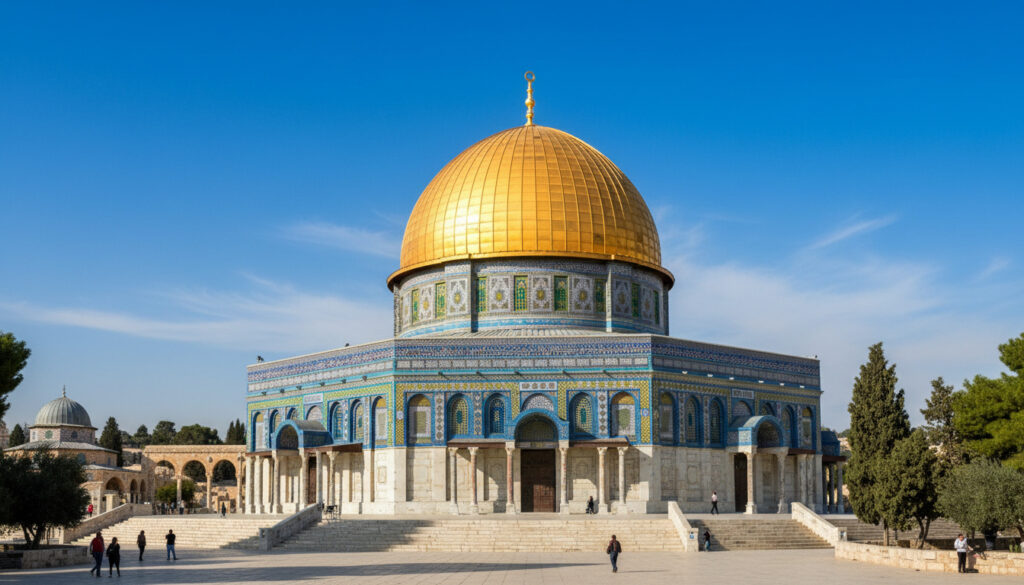
The golden dome dominates Jerusalem’s skyline, visible from vantage points across the ancient city. This Islamic shrine, completed in the late seventh century, stands atop the Temple Mount as one of the most recognizable monuments in the Middle East.
Constructed between 685 and 692 CE by the Umayyad Caliph Abd al-Malik, the Dome of the Rock houses a sacred rock linked to Prophet Muhammad’s night journey. The structure represents the oldest surviving Islamic monument, predating even the Great Mosque of Damascus by several decades.
Unlike typical mosques built primarily for prayer, this octagonal edifice functions as a shrine and pilgrimage destination. Its location carries profound significance for Judaism and Christianity as the historical site of Solomon’s Temple, creating layers of religious meaning that continue to influence regional politics today.
What is the Dome of the Rock?
691 CE by Abd al-Malik
Temple Mount, Jerusalem
Islamic Shrine
20-meter Golden Dome
- Not a mosque: Unlike Al-Aqsa nearby, this structure serves as a shrine commemorating Muhammad’s ascension.
- Octagonal design: The building follows an eight-sided plan influenced by Byzantine Christian architecture.
- Sacred rock: The central stone marks where Muslims believe Muhammad ascended to heaven during the Miʿraj.
- Oldest Islamic monument: Completed in 692 CE, it remains the earliest surviving major Islamic architectural work.
- Dual ambulatories: Visitors walk through two concentric corridors circling the central rock.
- Ottoman restoration: Suleiman the Magnificent added the distinctive exterior tiles in the mid-16th century.
- Geopolitical flashpoint: The site sits at the center of competing Israeli and Palestinian claims to Jerusalem.
| Attribute | Details |
|---|---|
| Construction Period | 685–692 CE |
| Commissioner | Umayyad Caliph Abd al-Malik |
| Architectural Style | Umayyad with Byzantine influences |
| Dome Diameter | 20 meters |
| Total Height | Approximately 55 meters |
| Interior Columns | 16 piers and columns |
| Exterior Columns | 24 in the outer arcade |
| Inscription Date | AH 72 (691/692 CE) |
| UNESCO Status | Part of Old City World Heritage buffer zone |
| Current Administration | Jordanian Waqf |
Who Built the Dome of the Rock and When?
The Umayyad Caliph Abd al-Malik commissioned the structure during the Second Fitna civil war, a period of internal conflict within the Islamic Caliphate. Historical records indicate construction began in 685 CE and concluded in 692 CE, lasting approximately seven years.
The Umayyad Commission
Abd al-Malik sought to establish a permanent Islamic presence in Jerusalem and create a pilgrimage focal point while Mecca’s Kaaba remained under hostile control. The project aimed to assert Umayyad religious authority and provide a monument that could unify the Muslim community during factional disputes.
Construction Supervision
Historical accounts name three primary supervisors: Raja ibn Haywa, a theologian from Beisan; Yazid ibn Salam, a Jerusalem native; and Baha al-Farisi. These individuals oversaw a workforce that incorporated both local craftsmen and expertise from across the expanding Islamic empire.
Dating the Structure
The building bears a dedicatory Kufic inscription dating to AH 72, corresponding to 691 or 692 CE. This epigraphic evidence confirms the completion date, though later alterations under Abbasid Caliph al-Ma’mun modified portions of the text to acknowledge subsequent rulers.
The interior bands of Kufic script contain the earliest surviving Quranic texts in architectural decoration. These gold-lettered inscriptions affirm Islamic monotheism and specifically reference the oneness of God, countering Christian Trinitarian doctrine prevalent in Byzantine Jerusalem.
Why is the Dome of the Rock Important?
Islamic Significance
Muslims believe the rock at the center marks the spot from which Prophet Muhammad ascended to heaven during his Night Journey (Miʿraj). Here, tradition holds, he met previous prophets and encountered the divine presence before returning to Mecca. The shrine commemorates this miraculous journey, making it the third holiest site in Islam after Mecca and Medina.
Jewish and Christian Connections
The structure sits atop the Temple Mount (Har haBayit), the location of Solomon’s Temple destroyed by Babylonians in 586 BCE and the Second Temple destroyed by Romans in 70 CE. For Jews, this represents the holiest site in Judaism, though religious law traditionally restricts entry to the area. Early Christian pilgrims also recognized the location, with some Byzantine sources noting a previous memorial church on the site.
Political Symbolism
The golden dome has become a potent symbol in the Israeli-Palestinian conflict, representing competing claims to Jerusalem’s sacred geography. Its presence visually asserts Islamic heritage in the city while its position atop the ancient Temple Mount underscores the layered histories that complicate modern peace negotiations.
What Architectural Features Define the Dome of the Rock?
The Golden Dome
The structure supports a 20-meter diameter dome rising approximately 35 meters above the platform. The original lead dome, installed in 691 CE, underwent multiple renovations. In the 1960s, authorities added gold-colored anodized aluminum, replaced again in 1993 due to corrosion issues. The multi-layered construction rests directly on bedrock, contributing to its stability despite frequent regional earthquakes.
Interior Design and the Sacred Rock
Two ambulatories encircle the central rock, which remains protected by a railing. Visitors cannot touch the stone, visible from the surrounding corridors. The interior features original Umayyad mosaics inspired by Byzantine artistic traditions, utilizing gold backgrounds and vegetal motifs rather than human figures.
The exposed rock surface measures approximately 13 meters by 17 meters. Muslim tradition identifies a footprint within the stone as Muhammad’s mark from the ascension, while Jewish tradition associates the rock with the Foundation Stone of the Temple.
Byzantine and Ottoman Influences
The octagonal plan directly references Christian martyria and Byzantine church architecture, particularly the nearby Church of the Holy Sepulchre. Ottoman Sultan Suleiman the Magnificent replaced the original Umayyad exterior mosaics with ceramic Iznik tiles between 1545 and 1552, completed under his successor Murad III. These tiles feature intricate floral patterns executed by Iranian craftsmen including Abdallah of Tabriz.
The structure represents a unique fusion of artistic traditions: Byzantine mosaics, Persian ceramic work, Arabic calligraphy, and Umayyad architectural innovation. This synthesis created a visual language that influenced Islamic architecture for centuries.
How Has the Structure Changed Over Time?
- : Completion under Abd al-Malik with original lead dome and mosaics.
- : Earthquake damages the structure, requiring repairs.
- : Additional earthquake damage recorded during the Abbasid period.
- : Main dome collapses following seismic activity.
- : Fatimid Caliph Ali az-Zahir rebuilds the collapsed dome.
- : Mosaics repaired and reinforced.
- : Suleiman the Magnificent installs exterior ceramic tiles.
- : Gold-colored anodized aluminum added to dome exterior.
- : Aluminum replaced due to rust and deterioration.
What Do We Know for Certain?
| Established Facts | Remaining Uncertainties |
|---|---|
| Built by Umayyad Caliph Abd al-Malik between 685–692 CE | Specific visiting hours and access rules as of 2026 |
| Located on the Temple Mount above ancient Jewish Temple site | Future renovation schedules or structural interventions |
| Functions as an Islamic shrine, not a mosque | Exact interior access policies for non-Muslim visitors |
| Dome collapsed in 1015 and was rebuilt | Resolution of ongoing sovereignty disputes |
| Inscription dates to AH 72 (691/692 CE) | Specific details of original Umayyad mosaic programs |
How Does It Compare to Al-Aqsa Mosque?
Visitors often confuse the Dome of the Rock with the Al-Aqsa Mosque, located approximately 200 meters south on the same platform. While both structures hold Islamic significance, they serve different religious functions and architectural purposes.
The Dome of the Rock functions specifically as a shrine commemorating the Miʿraj, housing the sacred rock and designed for circumambulation rather than congregational prayer. Al-Aqsa Mosque, constructed later in the Umayyad period, operates as the primary prayer hall for the compound, featuring a traditional qibla orientation and larger capacity for worshippers.
Architecturally, the Dome of the Rock rests on bedrock, providing greater seismic stability than Al-Aqsa, which has suffered more extensive earthquake damage throughout history. The golden dome distinguishes the shrine visually, while Al-Aqsa maintains a simpler lead-covered roof. Understanding these distinctions helps visitors navigate the complex and appreciate the specific religious protocols governing each site.
Travelers planning extensive regional tours might consult the Pound to Euro Forecast – 2025 Review and 2026 Outlook for budgeting multi-country itineraries that include both Israel and European destinations.
What Do Historical Sources Confirm?
The dedicatory inscription in Kufic script represents the earliest dated Quranic text in architectural form, providing concrete evidence of the building’s completion in the late seventh century.
— Historical epigraphic analysis, Metropolitan Museum of Art
Arab historians including al-Tabari and Ibn al-Faqih confirm Abd al-Malik’s role as commissioner, explicitly rejecting later myths attributing construction to Byzantine emperors or earlier caliphs.
— Medieval chroniclers, Life in the Holy Land
What Should Visitors Know?
Access to the Temple Mount complex remains restricted and subject to change based on security conditions. Non-Muslims typically enter through the Mughrabi Gate near the Western Wall, undergoing security screening before ascending wooden ramps to the platform. The site opens during daytime hours but closes during all Islamic prayer times, including midday Friday services.
Modest dress codes apply strictly: covered shoulders and knees for all visitors, with no religious articles or texts visible. Non-Muslims cannot enter the Dome of the Rock interior itself, restricted to the outer platform and viewing the exterior architecture. Photography requires discretion and should never include Muslim worshippers without permission.
Those seeking additional local services while in London might reference Private Dentist Near Me – Your Guide to Local Options for healthcare planning before departing on pilgrimage or historical tours.
Frequently Asked Questions
What does the golden dome symbolize?
The golden dome represents Islamic triumph and divine presence, with the color gold symbolizing the glory of heaven and the sacred nature of Muhammad’s ascension from the rock beneath.
Can tourists enter inside the Dome of the Rock?
Non-Muslims cannot enter the interior, which remains restricted to Muslim visitors. Tourists may view the exterior and walk the surrounding platform but cannot access the ambulatories or view the sacred rock up close.
Is the Dome of the Rock the same as the Temple?
No. The Islamic shrine stands atop the ruins of the Jewish Temples destroyed in 586 BCE and 70 CE, but the current structure dates to 691 CE and serves Islamic religious purposes.
Why is it called the Dome of the Rock?
The name derives from the Arabic Qubbat al-Sakhra, referring to the large rock protrusion at the center of the shrine, believed to be the stone from which Muhammad ascended to heaven.
Who controls the site today?
The Jordanian Waqf administers religious affairs under Israeli sovereignty, maintaining a complex status quo that restricts non-Muslim prayer and regulates access to the compound.
Has the dome always been gold?
Originally covered in lead, the dome received gold-colored aluminum in the 1960s, replaced in 1993. The current golden appearance dates from these modern renovations rather than the original Umayyad construction.
What happened to the original mosaics?
Suleiman the Magnificent removed the original Umayyad exterior mosaics in the 16th century, replacing them with ceramic tiles. Some interior mosaics from the 7th century remain visible today.
More related posts
 ASICS GEL-NYC Oyster Grey: Buy, Fit & Style Guide (Ireland)
 The Ivy Asia Leeds – Menu Prices, Bookings and Reviews Guide
 How Many Children Does Boris Johnson Have? At Least 8
 Ca t of The Little Mermaid (2023 Film): Full Li t, Role & In ight
 Wilbur and Orville Wright: Biography, First Flight & Facts
 Private Dentist Near Me – Your Guide to Local Options
 Money Transfer Credit Card: How to Send Money & Best Cards
 What Is a Limited Company? Simple Explanation, Tax & Requirements