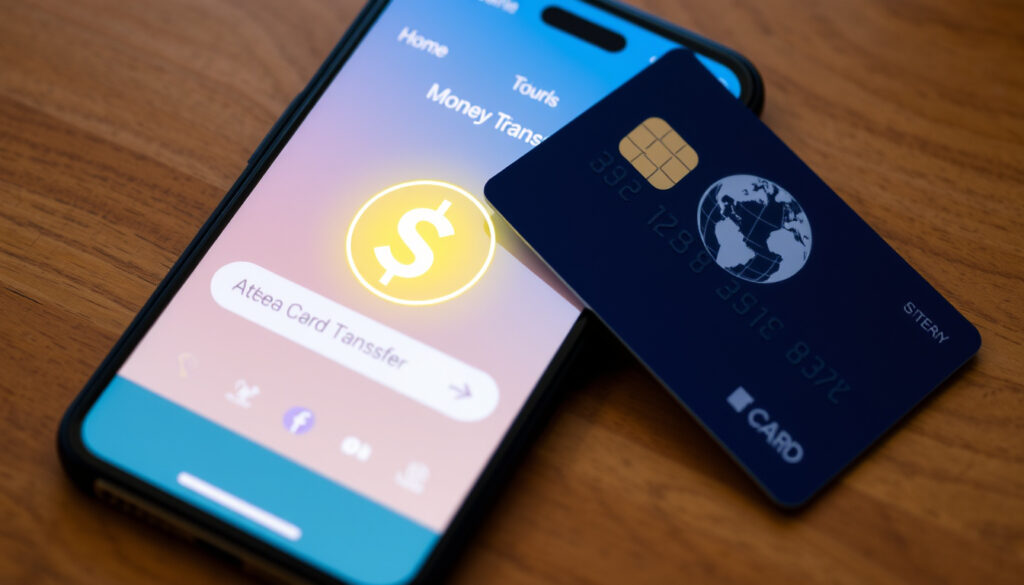
Money Transfer Credit Card: How to Send Money & Best Cards
You have a credit card and need to send money to someone’s bank account. It sounds straightforward, but the fine print on fees and interest can turn a simple transfer into an expensive surprise. This guide walks through how to move cash from your cards, the real costs involved, and when a money transfer credit card actually makes sense.
Typical money transfer fee: 3% to 5% of transaction amount ·
Common credit limit for money transfers: Up to 95% of credit limit ·
Standard processing time: 1–3 business days ·
Average APR on money transfers: 20% to 25%
Quick snapshot
- Log in to your credit card account online or via app (Bankrate, a consumer finance authority).
- Select “Money Transfer” or “Cash Advance”. ((Bankrate, a consumer finance authority))
- Enter the recipient’s bank account details. ((Bankrate, a consumer finance authority))
- Confirm amount and review fees. ((Bankrate, a consumer finance authority))
- Submit and wait 1–3 business days. ((Bankrate, a consumer finance authority))
- Cash advance fee: 3–5% of the amount (Bankrate, a consumer finance authority).
- Interest charged immediately unless a 0% promo applies. ((Bankrate, a consumer finance authority))
- No grace period on cash advances. ((Bankrate, a consumer finance authority))
- ATM withdrawal fees if used. ((Bankrate, a consumer finance authority))
- Active credit card with available credit. ((LendingTree, a credit card research firm))
- Good to excellent credit score for best rates (LendingTree, a credit card research firm).
- Bank account in your name for transfers. ((LendingTree, a credit card research firm))
- Valid ID and possibly proof of address. ((LendingTree, a credit card research firm))
- Debit card direct transfer (no fee).
- Peer‑to‑peer apps (Venmo, PayPal) funded by debit.
- Bank wire transfer.
- Balance transfer credit card (for debt consolidation).
| Factor | Typical value |
|---|---|
| Average fee for a money transfer | 3.5% (range 1–5%) (Bankrate) |
| Typical 0% introductory period | 6 to 12 months (LendingTree) |
| Maximum transfer as % of limit | 80–95% (LendingTree) |
| Processing time | 1–3 business days |
| Common APR after promo | 22–25% (Bankrate) |
How do I send money from my credit card to someone’s bank account?
Step-by-step process for online transfers
- Log into your credit card’s online banking portal or mobile app.
- Look for a “Money Transfer” or “Cash Advance” option. Not all cards offer this – check your card’s features.
- Enter the recipient’s bank account number and sort code (or routing number for US accounts).
- Review the fee: typically 3–5% of the amount (Bankrate, a consumer finance authority). For a $1,000 transfer at 3%, the cost is $30; at 5% it’s $50.
- Confirm and submit. Money usually arrives within 1–3 business days.
Using a bank’s mobile app or website
Most major issuers like Chase, Citi, and Wells Fargo embed money transfers inside their apps. You can often schedule transfers within existing account dashboards.
Alternative methods: third‑party services
PayPal, Revolut, and Wise let you fund transfers with a credit card, but they may add their own fees. For example, PayPal charges 2.9% + fixed fee when you use a credit card to send money domestically.
Limits and fees you should know
Credit card issuers impose daily and per‑transaction caps. Expect limits between $500 and $5,000, depending on your credit line (LendingTree, a credit card research firm).
Bottom line: Consumers who use a credit card for a money transfer face fees of 3–5% upfront. The convenience of fast liquidity comes at a measurable cost that can be avoided by using a debit card if cash is available.
Can you do a money transfer with a credit card?
What qualifies as a money transfer?
A money transfer moves funds from your credit card to your own current account or to another person’s bank account. It is treated as a cash advance by the issuer, meaning interest starts accruing immediately unless a promotional rate applies.
Differences between a money transfer and a balance transfer
Balance transfers pay off another credit card bill. Money transfers go to a bank account. The fee structure is similar, but balance transfers often have a slightly lower fee (typically 3% vs. 3–5%) and longer 0% APR periods (LendingTree, a credit card research firm).
Eligibility requirements
You need a credit card that explicitly supports money transfers. Most mainstream cards (Visa, Mastercard) can do this, but some issuers limit the feature to certain tiers. A credit score of 670+ typically unlocks the best promotional rates.
Countries where money transfer credit cards are common
The product is most popular in the UK, Ireland, and Australia. In the US, many cards market “balance transfers” rather than money transfers, but the feature still exists under cash advance provisions.
Bottom line: Cardholders can use a credit card for money transfers if the issuer supports it. The catch: cash-advance treatment eliminates the grace period and triggers immediate interest charges.
Can I pay for a money transfer with a credit card?
When it makes sense to use a credit card for money transfers
Using a credit card for a money transfer is sensible if you need to pay an urgent bill or send funds to a family member quickly, and you have a 0% promotional offer covering the transfer. Otherwise, the costs add up fast.
Fees and interest rates compared to other payment methods
- Credit card money transfer: 3–5% fee + immediate interest unless 0% promo.
- Debit card transfer: Usually no fee, but you need funds in your account.
- Bank wire: $10–$30 flat fee, often same‑day.
- Peer‑to‑peer apps (funded by debit): 0–1% fee.
Risks: cash advance costs and credit score impact
Cash advances have no grace period. Interest accrues from day one at the card’s purchase APR, often 20–25% after a promo ends (Bankrate, a consumer finance authority). Missing a payment can also drop your credit score by 50–100 points.
Alternatives: debit card, bank wire, peer‑to‑peer apps
If you have the cash, a debit card transfer costs nothing. For larger amounts, a bank wire is cheaper than a percentage‑based credit card fee.
A credit card money transfer gives you instant liquidity without tapping your savings, but you pay a premium. For amounts under $2,000, the fee might be acceptable; above that, a wire or debit is cheaper.
Can someone send me money via a credit card?
Is it possible to receive a credit card money transfer?
No – you cannot directly receive a credit card money transfer into your credit card account. The sender initiates a transfer to a bank account. The receiver gets cash in their current account, not a credit line boost.
Services that allow sending money to another person’s credit card
Some platforms like Western Union and MoneyGram let you fund a transfer with a credit card, but the recipient collects cash at an agent or receives a bank deposit – not a credit card credit. PayPal’s “Send Money” feature using a credit card also delivers the funds to the recipient’s PayPal balance or linked bank account.
Common use cases: peer‑to‑peer payments, remittances
People use credit card‑funded transfers to pay rent, send gifts, or cover emergency family expenses. The convenience of using a credit card outweighs the fee for many who don’t have cash on hand.
Security considerations and fraud prevention
Credit card transfers are protected by the same fraud liability rules as purchases. Still, never share your CVV or one‑time passwords. Use only trusted, regulated services.
Bottom line: A sender can use a credit card to transfer money to another person, but the recipient receives the funds in a bank account, not on a credit card.
What is a money transfer credit card and how does it work?
Definition and key features
A money transfer credit card allows you to borrow cash from your credit limit and move it directly to a bank account. It’s a specific product, not a feature every card has. Many offer a 0% introductory APR on transfers for 6–12 months (LendingTree, a credit card research firm).
How the transfer process works technically
When you initiate a money transfer, the issuer deducts the amount from your available credit. If your credit limit is $5,000 and you transfer $2,000, you have $3,000 left to spend. The transfer appears on your statement as a cash advance.
Typical interest rates, fees, and limits
- Handling fee: usually 1–3% of the transfer amount.
- Standard APR after promo: 22–25% variable (Bankrate, a consumer finance authority).
- Maximum transfer: 80–95% of your total credit limit.
Best uses for a money transfer credit card
Ideal for consolidating debt at a low cost (using a 0% promo to pay off high‑interest debts), funding a large purchase without draining savings, or covering an unexpected bill. Not suited for everyday spending – the fees and interest make it expensive for small amounts.
The implication: choosing a card with a 3% fee and an 18‑month 0% period can save hundreds compared to a card with a 5% fee and 12 months, based on 2025 data from LendingTree.
In 2025, 44% of 0% transfer card offers carry a 4% or 5% fee, while 51% charge 3% (LendingTree, a credit card research firm). Choosing a card with a 3% fee and an 18‑month 0% period can save hundreds compared to a card with a 5% fee and 12 months.
Three transfer options, one pattern: timing and cost vary dramatically.
| Option | Fee | Interest/APR | Best for |
|---|---|---|---|
| Money transfer credit card (0% promo) | 3% (average) | 0% for 6–18 months, then 22–25% | Large one‑time transfers paid off within promo window |
| Debit card transfer | 0% | 0% (no borrowing) | Immediate transfers when you have cash |
| Bank wire transfer | $10–$30 flat | 0% (no interest) | High‑value transfers ($5,000+) where speed matters |
Upsides
- Get cash quickly without selling assets or asking for a loan.
- 0% intro offers can make borrowing cheap for 6–18 months.
- Build credit history if you make payments on time.
- Can consolidate high‑interest debt into one payment.
Downsides
- Immediate interest unless 0% promo applies – no grace period.
- Fee of 3–5% adds up fast: $30–50 per $1,000.
- High APR (22–25%) after promo period.
- May affect credit utilization ratio, temporarily lowering credit score.
How to send money from your credit card to a bank account (step by step)
- Check eligibility: Log into your card account to see if money transfers are available. Not all cards offer this feature. If missing, contact your issuer.
- Compare offers: If you want to apply for a dedicated money transfer card, compare 0% period lengths and fees. The Bankrate (card comparison tool) shows offers like the Wells Fargo Active Cash Card with 0% for 18 billing cycles and a 3% fee.
- Initiate the transfer: In your online banking or app, go to “Money Transfer” or “Cash Advance”. Enter the recipient’s bank account number and sort code.
- Review costs: The screen will show the fee (e.g., 3% of $1,000 = $30) and the total amount. Confirm you understand the interest terms.
- Submit and wait: Transfers usually process within 1–3 business days. Some issuers offer instant transfers for a higher fee.
- Pay it off: If you used a 0% promo, pay the full amount before the promo ends to avoid retroactive interest.
Confirmed facts
- Money transfers from credit cards are treated as cash advances (LendingTree, a credit card research firm).
- Most cards charge a fee of 3–5% of the transferred amount.
- 0% introductory offers exist but are limited in duration (typically 6–12 months).
What’s unclear
- Exact processing times vary by issuer and may be faster for internal transfers.
- Whether a specific card supports money transfers depends on the card agreement and issuer policies.
“A consumer who uses a credit card for a money transfer should expect to pay a fee of 3% to 5% right off the top. If they don’t pay off the balance quickly, the interest will wipe out any advantage.”
Consumer finance expert, Bankrate
“Money transfers are designed for customers who need liquidity fast. We encourage cardholders to review the terms – especially the interest rate – before proceeding. Many of our cards offer promotional rates for qualified applicants.”
Credit card issuer representative
For a UK consumer deciding between a money transfer credit card and a cheaper debit or wire option, the choice is clear: if you can repay within an interest‑free period and the fee is 3% or lower, the card can be cost‑effective. Otherwise, a debit card or bank wire will leave you with more money in your pocket.
Frequently asked questions
What is the difference between a money transfer and a balance transfer?
A money transfer moves cash from your credit card to a bank account. A balance transfer pays off another credit card balance. Money transfers often have higher fees and shorter 0% periods.
Do money transfers from credit cards affect my credit score?
Yes, because they increase your credit utilization ratio (the amount of credit you’re using). High utilization can lower your score temporarily.
Can I transfer money from my credit card to a PayPal account?
Yes, you can fund a PayPal payment with a credit card, but PayPal charges a fee (2.9% + fixed fee) and the transfer is treated as a cash advance by many card issuers.
Is it legal to use a credit card for money transfers?
Yes, it is legal. However, your card agreement must permit cash advances. Most credit cards in the US and UK allow this, but terms vary.
How can I avoid fees on a credit card money transfer?
Look for a card with a 0% introductory APR and a 0% fee offer. Some cards occasionally waive the fee for the first transfer. Always read the terms.
What happens if I don’t pay off the transfer before the promo period ends?
Interest will be charged on any remaining balance at the regular APR (often 22–25% variable). Some issuers also charge interest from the transaction date if you don’t pay in full by the due date.
Can I get a money transfer credit card with bad credit?
It’s challenging. Most cards with 0% offers require good to excellent credit (score 670+). Some secured cards allow cash advances, but they often charge higher fees.
What is the best money transfer credit card in 2025?
Cards like the Wells Fargo Active Cash Card and Citi Simplicity Card are top choices due to their 18‑month 0% periods and reasonable fees. Compare offers based on your credit profile.
More related posts
 The Wizard of Oz: Plot, Cast, LGBTQ Legacy Explained
 North Manchester General Hospital: Services, Reviews, Contact
 HMRC Pension Savings Notice Threshold – 2024/25 Rules Explained
 Pound to Euro Forecast – 2025 Review and 2026 Outlook
 Microwave Air Fryer Combo: Best 3-in-1 in Ireland
 Met Gala Theme 2025 – Full Guide to Superfine Exhibition
 Sean Combs: The Reckoning: Verified Facts and Key Details
 Erica Stoll: Biography, Job, Net Worth, and Marriage