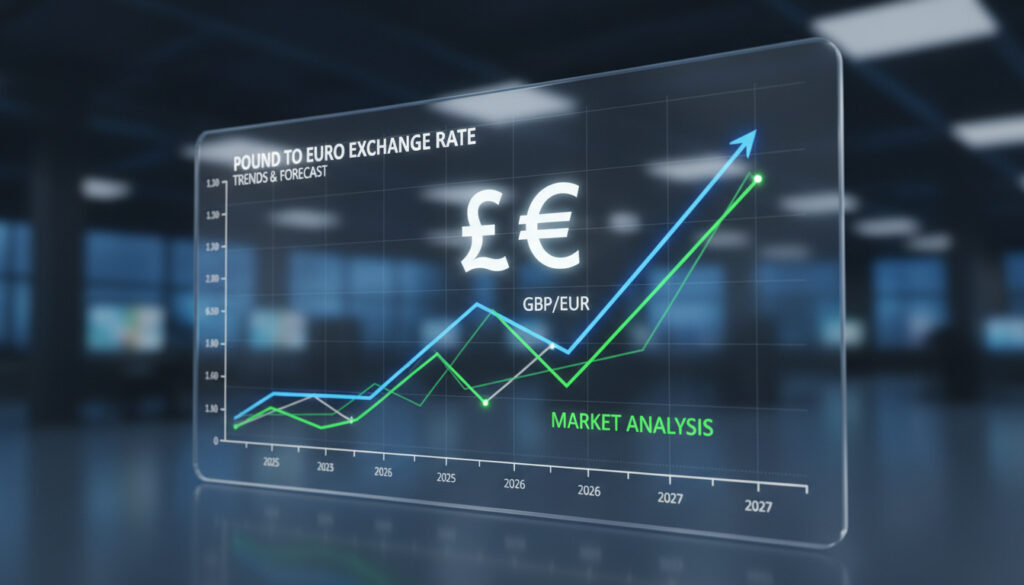
Pound to Euro Forecast – 2025 Review and 2026 Outlook
The pound-to-euro exchange rate concluded 2025 at 1.1450, marking sterling’s first annual decline against the single currency since 2022. After opening the year near 1.2090, the cross suffered persistent pressure from domestic fiscal tightening and shifting monetary policy expectations, eventually testing 30-month lows at 1.1308 during November.
Sterling volatility remained contained throughout the period, with 30-day measurements hovering near 0.37% despite significant fundamental shifts. Technical indicators suggest neutral market positioning, while analyst forecasts for the year diverged sharply between bullish targets near 1.2660 and bearish warnings of deterioration toward 1.15.
Current spot rates have recovered marginally toward the 1.20 handle, though the trajectory for 2026 hinges on the Bank of England’s easing cycle relative to the European Central Bank’s policy stance.
What is the latest pound to euro forecast?
- Sterling recorded its first annual loss versus the euro since 2022, closing 2025 at 1.1450 after starting at 1.2090
- Annual average exchange rate settled at 1.1672, with intraday peaks reaching 1.212 and troughs hitting 1.1308 on November 13
- Thirty-day volatility remains suppressed at 0.37%, indicating limited market panic despite substantive price movements
- Relative strength index (RSI) reads 55.52, suggesting neither overbought nor oversold conditions in the near term
- Technical positioning shows the rate holding above both 50-day and 200-day simple moving averages when viewed through the EUR/GBP inverse
- Early 2025 pressure stemmed specifically from UK tax adjustments, wage inflation, and heightened government borrowing requirements
- Consensus forecasts targeting 1.22 proved optimistic as actual performance diverged toward the lower bound of analyst ranges
| Metric | Value | Date | Source |
|---|---|---|---|
| Spot Rate | 1.2037 | Early 2025 | ForexFactory |
| 2025 Opening | 1.2090 | Jan 2025 | Currency News |
| 2025 Closing | 1.1450 | Dec 2025 | Currency News |
| Annual Average | 1.1672 | 2025 | ExchangeRates.org.uk |
| 52-Week High | 1.2120 | 2025 | Currency News |
| 52-Week Low | 1.1308 | Nov 13, 2025 | Currency News |
| 30-Day Volatility | 0.37% | Dec 2025 | CoinCodex |
| RSI (30-Day) | 55.52 | Dec 2025 | CoinCodex |
| End-2024 Level | 1.2050 | Dec 2024 | Investing.com |
Will the pound strengthen against the euro?
Institutional forecasts for 2025 anticipated modest strengthening toward the 1.22 level, supported by expectations of UK economic outperformance relative to the eurozone. HSBC maintained a bullish target of 1.25, while Goldman Sachs projected 1.2660 citing sterling’s procyclical nature and limited tariff exposure. ING positioned at 1.22, though warning that aggressive Bank of England easing could undermine the rally.
Actual performance diverged significantly from these projections. RBC Capital Markets proved most prescient among major banks, having warned of deterioration to 1.1765 on the back of UK economic deterioration and currency overvaluation. The eventual close at 1.1450 validated bearish concerns while underscoring the difficulty of forecasting fiscal policy impacts.
Analyst targets for end-2025 ranged from RBC’s 1.1765 to Goldman Sachs’ 1.2660, yet actual closing rates hit 1.1450. This 120-pip dispersion below the most bearish institutional forecast underscores the unpredictability of fiscal policy impacts and central bank reaction functions.
2026 Outlook and Policy Scenarios
Forward-looking consensus for 2026 suggests limited losses toward 1.1360, though dispersion remains wide. MUFG forecasts a sharper decline to 1.11, premised on sustained Bank of England easing against a European Central Bank holding steady at 2.25%. CoinCodex algorithmic models project EUR/GBP at 0.8747, implying GBP/EUR near 1.144.
For 2026, forecasts cluster between 1.11 and 1.144, with MUFG predicting sharper declines toward 1.11 based on Bank of England easing against a potentially steady European Central Bank. This contrasts with early 2025 expectations of modest sterling appreciation.
What factors affect the GBP to EUR exchange rate?
Monetary Policy Divergence
Interest rate differentials remain the primary driver of sterling-euro valuations. The Bank of England implemented four cuts during 2025, reducing the base rate significantly from previous peaks. Markets continue pricing aggressive easing for 2026, with ING suggesting potential for 150 basis points of cuts against current market expectations of 55 basis points. Conversely, the European Central Bank completed 3.15 percentage points of cumulative cuts, with potential to hold rates at 2.25% through the forecast period.
Domestic Fiscal Pressures
UK-specific fiscal measures exerted sustained downward pressure throughout 2025. Tax hikes, wage growth acceleration, and new employment regulations increased operational costs for British businesses. Elevated government borrowing requirements simultaneously expanded gilt supply and raised concerns about fiscal sustainability. These factors compounded monetary easing effects to undermine sterling support.
Macroeconomic Indicators
Inflation dynamics diverged between jurisdictions. UK headline inflation peaked at 3.8% during 2025 before settling at 3.2% by year-end, while core measures followed similar trajectories. Gross domestic product growth stalled throughout the second half of 2024, carrying momentum weakness into early 2025. Eurozone growth remained subdued but stable, providing relative support for the single currency.
What is the historical performance of GBP vs EUR?
The 2025 trading year marked a decisive break from recent trends. After three consecutive years of resilience or gains, sterling succumbed to domestic pressures and policy divergence. The cross traded below its five-year average through late 2025, having recovered only partially from the November 13 nadir at 1.1308.
Quarterly volatility remained pronounced despite low headline volatility metrics. The first quarter saw gradual erosion from 1.2090 toward 1.20, while the second quarter briefly stabilized near 1.1760. Third quarter weakness accelerated toward the 1.13 handle before a modest fourth quarter recovery.
The 2025 decline marked sterling’s first annual loss against the euro since 2022, reversing a three-year trend of relative resilience. The November low at 1.1308 represented a 30-month nadir, testing levels not seen since early 2023.
How has the GBP/EUR rate evolved through recent key events?
- : GBP strengthened against EUR on tariff-related flows, closing the year at 1.2050 Goldman Sachs
- : EUR/GBP climbed to September 2024 highs as UK tax hikes and wage increases pressured sterling FXOpen
- : Rate recorded at 1.1769 during mid-year consolidation ExchangeRates.org.uk
- : GBP/EUR hit annual low of 1.1308, representing a 30-month trough Currency News
- : Currency pair closed at 1.1450, recording first annual loss since 2022 Currency News
What is certain versus uncertain about the GBP/EUR outlook?
| Established Information | Information That Remains Unclear |
|---|---|
| 2025 closed at 1.1450 with 1.1672 annual average | Magnitude of 2026 BoE cuts (150bp vs 55bp market pricing) |
| UK inflation peaked at 3.8%, ending at 3.2% | Whether ECB holds rates at 2.25% through 2026 |
| Volatility historically low at 0.37% | Impact of ongoing UK fiscal adjustments on growth |
| BoE implemented easing throughout 2025 | Direction of US trade tariff policies affecting both jurisdictions |
| November 2025 marked 30-month lows at 1.1308 | Exact timing of recovery toward 1.20+ handle |
Why does the pound-to-euro exchange rate matter?
The sterling-euro cross represents one of the most liquid currency pairs globally, facilitating substantial daily trade volumes between the United Kingdom and European Union. For UK importers, a weaker pound increases input costs denominated in euros, while exporters gain competitiveness in continental markets. Met Gala Theme 2025 – Full Guide to Superfine Exhibition For those interested in other major sporting events, the UEFA Women’s Champions League 2024-25 also saw significant developments.
Beyond commerce, the exchange rate directly affects inflation differentials through import prices, influencing monetary policy decisions at both the Bank of England and European Central Bank. The 2025 decline to 1.1450 effectively transferred purchasing power from UK consumers to eurozone holders of sterling assets, highlighting the currency’s role as an economic shock absorber.
Investment flows between these major economies remain sensitive to relative yield differentials, with the 2025-2026 pivot toward Bank of England easing potentially altering portfolio allocations toward euro-denominated instruments.
What are analysts saying about the GBP/EUR outlook?
HSBC forecasts GBP/EUR at 1.25 based on UK outperformance versus the eurozone despite headwinds, while RBC warns of weakening to 1.1765 due to UK economic deterioration and overvaluation.
— Investing.com Analyst Roundup, 2025
The pound remains procyclical with lower tariff risks compared to other currencies, suggesting resilience during periods of global trade stress.
— Goldman Sachs Global Investment Research
Sterling’s decline to 1.1450 marked the first annual loss since 2022, with the pair recovering from 1.13 lows but trading below the five-year average by year-end.
— Currency News Annual Review
What is the bottom line for the pound-to-euro forecast?
Sterling enters 2026 on the defensive after a disappointing 2025 that saw the pound shed value against the euro for the first time in three years, closing at 1.1450. While volatility remains contained and technical indicators neutral, the fundamental outlook favors further pressure as the Bank of England continues easing against a potentially steadier European Central Bank. What Football Is on TV Today – No NFL, Soccer or College Games March 30 2026
Frequently Asked Questions
Is now a good time to exchange pounds for euros?
Timing depends on risk tolerance. The rate ended 2025 at 1.1450, recovering from November lows of 1.1308. With volatility at 0.37%, hedging may suit those needing certainty, though 2026 forecasts suggest potential further weakness toward 1.11 according to MUFG.
How do interest rates impact GBP/EUR forecast?
Rate divergence drives the exchange rate. The BoE implemented easing in 2025 while markets priced further cuts for 2026, whereas the ECB potentially holds at 2.25%. This narrowing yield advantage historically pressures sterling toward the lower bound of trading ranges.
What is the current pound to euro rate?
Recent spot rates hovered near 1.2037, though 2025 closed at 1.1450. Technical indicators show neutral sentiment with RSI at 55.52, trading above both 50-day and 200-day moving averages.
Will the pound strengthen to 1.25 against the euro?
HSBC forecast 1.25 for end-2025, but actuals fell to 1.1450. For 2026, consensus sees limited losses to 1.1360, though bullish scenarios depend on UK outperforming the eurozone and aggressive ECB easing that fails to materialize.
What was the lowest pound to euro rate in 2025?
The sterling-euro cross hit 1.1308 on November 13, 2025, representing a 30-month low before recovering to close the year at 1.1450.
How volatile is the GBP/EUR pair?
Volatility remains historically low, measuring 0.37% over 30 days with neutral market sentiment. This procyclical currency pair typically sees heightened sensitivity during UK GDP releases and central bank announcements.
What drives short-term pound to euro movements?
Short-term dynamics reflect UK fiscal policy changes including tax adjustments and wage regulations, alongside ECB policy expectations and relative inflation data between the jurisdictions.
More related posts
 Buy Mounjaro Online UKMeds.co.uk: Prices from £157.99
 Dome of the Rock – History Significance Architecture Guide
 England National Football Team: Squad News & History
 What Is a Riser Desk? Types, Benefits, and Key Comparisons
 India vs New Zealand 2026: Watch, Schedule & Free Streaming
 Eugene Levy: Biography, Family, Net Worth, and Why He’s Famous
 BP Share Price LSE – Live Price, Charts and Key Metrics
 Sky Broadband Customer Service Number: UK & Ireland Numbers