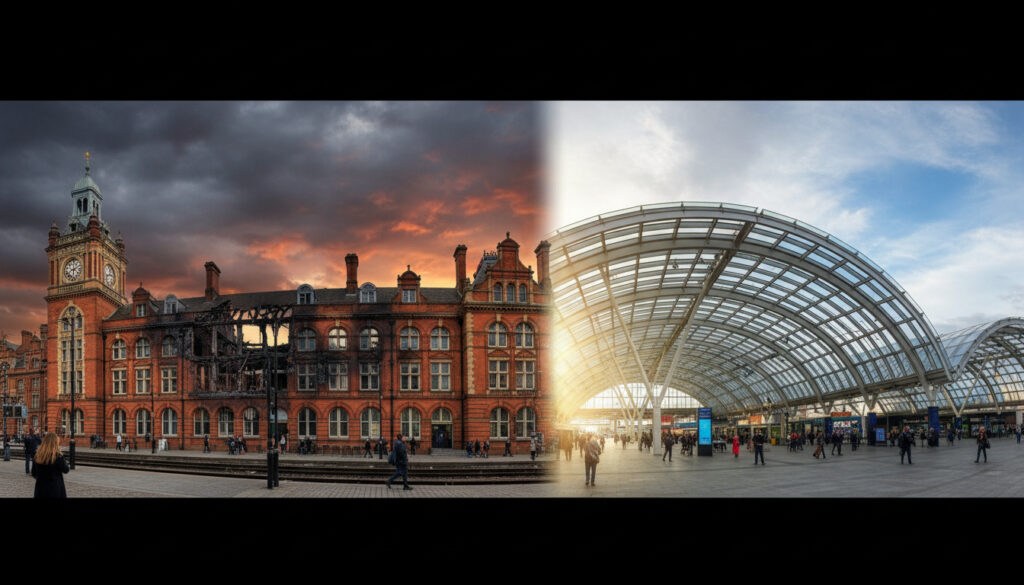
King’s Cross – Station History, 1987 Fire and Regeneration
King’s Cross functions as one of London’s most critical transport interchanges and regenerated urban districts. Once defined solely by its industrial railway heritage and scarred by the tragic 1987 fire, the area has evolved into a vibrant cultural destination attracting millions of visitors annually. The station complex anchors a 67-acre redevelopment that blends Victorian architecture with modern tech campuses, retail spaces, and public squares.
Located in Central London immediately adjacent to St Pancras International, the hub serves six Underground lines plus National Rail services. The district now houses Google’s UK headquarters, the famous Harry Potter Platform 9¾ attraction, and the rejuvenated Coal Drops Yard shopping area. This evolution from transport terminus to lifestyle destination represents one of the capital’s most substantial urban regeneration projects.
Understanding King’s Cross requires examining both its functional role as a travel gateway and its complex history of disaster and renewal. The 1987 Underground fire, which killed 31 people, fundamentally changed safety protocols across the network, while the subsequent thirty-year regeneration programme has created a new model for mixed-use urban development.
What Is King’s Cross and Where Is It Located?
King’s Cross sits in the London Borough of Camden, immediately north of the city centre. The station opened in 1852 as the London terminus for the Great Northern Railway, establishing the area as a primary gateway for rail travel from the north of England and Scotland.
Central London, adjacent to St Pancras International
Major rail hub connecting six Underground lines and National Rail
Platform 9¾, Granary Square, and the 1987 fire safety legacy
Explore Coal Drops Yard for restored Victorian warehouse shopping
Key Insights
- The station handles millions of passengers annually across six Tube lines and rail services
- The site remains the location of the deadliest fire in London Underground history, killing 31 people in 1987
- Extensive regeneration transformed a 67-acre industrial site into a £3 billion-plus cultural district
- The area hosts Google’s major UK campus, employing thousands and anchoring a tech ecosystem
- Victorian heritage structures stand alongside modern developments like Coal Drops Yard and Granary Square
- Direct interchange with St Pancras International provides immediate Eurostar access to continental Europe
Essential Facts
| Fact | Details |
|---|---|
| Opened | 1852 (Great Northern Railway terminus) |
| Annual Passengers | Approximately 30 million (pre-2020) |
| Underground Lines | Piccadilly, Northern, Victoria, Circle, Hammersmith & City, Metropolitan |
| Adjacent Hub | St Pancras International (Eurostar terminal) |
| 1987 Fire Fatalities | 31 (30 on-site, 1 later in hospital) |
| 1987 Fire Injuries | Over 100 people |
| Safety Inquiry | Fennell Report (1988) with 157 recommendations |
| Wooden Escalator Removal | Completed 2014 across network |
| Regeneration Site | 67 acres (King’s Cross Central) |
| Google Campus Period | Construction phases 2017–2025 |
What Happened in the King’s Cross Fire?
On 18 November 1987, a fire beneath a wooden escalator serving the Piccadilly line platforms initiated the deadliest disaster in London Underground history. The blaze started around 19:25 when a lit match ignited accumulated grease, litter, and debris under the escalator according to investigative reports.
Timeline of the Incident
Smoke became visible to passengers by 19:37, triggering an evacuation order at 19:40. The first fire engines arrived at 19:42. However, the fire had already spread via the “trench effect,” where flames accelerated up the inclined escalator shaft. At approximately 19:45, a flashover occurred in the ticket hall, producing a jet of flame and toxic smoke that killed most victims instantly, including Station Officer Colin Townsley of the London Fire Brigade reports the Fire Brigades Union.
The station cleared by 19:55, though the fire burned until 01:46 the following day. The response involved 35 fire crews, over 150 firefighters, and 14 ambulances. The official inquiry later established that staff lacked fire training and response protocols were dangerously delayed according to the McNulty-Rielly report.
Causes and Aftermath
The Fennell Report, published in 1988, attributed the disaster to institutional complacency and poor communication systems. The investigation documented that London Underground staff received no fire training and that radio equipment failed to function underground. The report issued 157 recommendations, mandating the replacement of all wooden escalators, installation of heat detectors and sprinklers, implementation of smoking bans, and upgrades to firefighter personal protective equipment Wikipedia archives detail.
The 1987 disaster catalysed the complete removal of wooden escalators from the entire Underground network, a process that concluded in 2014—nearly three decades after the fire. Modern stations now feature non-combustible materials, automatic sprinkler systems, and mandatory staff evacuation training.
What to Do in King’s Cross: Top Attractions
The regenerated district offers distinct zones for shopping, culture, and entertainment. The transformation of industrial infrastructure into public spaces provides visitors with architectural heritage alongside contemporary amenities.
Granary Square and Coal Drops Yard
Granary Square opened in 2013 as the regeneration’s central public space, featuring fountains and hosting seasonal events. The square connects to the University of the Arts London campus, creating a continuous creative quarter. Adjacent Coal Drops Yard comprises Victorian coal warehouses reopened in 2018, now containing over 50 stores, restaurants, and pop-up retail spaces. The Thomas Heatherwick-designed structures retain their historic brickwork while accommodating modern brands.
Platform 9¾ Experience
The Harry Potter-themed attraction within the mainline station draws global visitors. A luggage trolley appears to disappear into the station wall, creating a photographic opportunity that references the fictional wizarding school platform. A dedicated shop sells franchise merchandise. The installation has operated since 2012, capitalising on the station’s literary connection.
Google Campus and Tech Scene
The “Google Lands” development, constructed in phases between 2017 and 2025, represents the district’s shift toward technology employment. The campus accommodates thousands of workers and anchors a broader tech ecosystem along the Regent’s Canal. The presence of major technology firms has accelerated local economic growth beyond retail and tourism.
The British Library stands immediately west of the station complex, offering free access to permanent collections including the Magna Carta and rotating exhibitions. The library’s proximity allows visitors to combine transit with cultural stops.
King’s Cross Redevelopment and Practical Information
The district’s transformation from industrial wasteland to mixed-use neighbourhood required decades of coordinated planning. Post-1987 safety upgrades preceded the major regeneration that began in earnest during the 2000s.
From Industrial Past to Cultural Hub
The King’s Cross Central masterplan, approved in the 2000s, redeveloped 67 acres of former railway lands. The project preserved Victorian gasholders—converted into apartments and event spaces—while introducing new construction. The £3 billion investment created thousands of construction and permanent jobs in retail, technology, and hospitality sectors. The area now functions as a model for transit-oriented development, where high-density employment and residential spaces integrate directly with transport infrastructure.
Safety and Getting Around
Contemporary King’s Cross operates under stringent safety protocols implemented following the Fennell recommendations. Modern fire suppression systems, CCTV coverage, and regular policing maintain low crime rates. The station complex remains open and well-lit throughout operating hours.
Six Underground lines converge here, providing direct connections to Heathrow Airport (Piccadilly line), the West End (Victoria and Northern lines), and the City (Circle, Hammersmith & City, Metropolitan lines). National Rail services connect to northern England and Scotland, while adjacent St Pancras International offers Eurostar services to Paris, Brussels, and Amsterdam.
While King’s Cross focuses on domestic and regional National Rail services alongside six Underground lines, St Pancras International specialises in international Eurostar routes and Thameslink suburban services. The two stations connect underground, allowing passengers to transfer between domestic, international, and local transit modes without surface exposure.
How Has King’s Cross Transformed Over Time?
-
Station opens as the Great Northern Railway’s London terminus, establishing the northern gateway. -
Devastating fire on 18 November kills 31 people and injures over 100, becoming the worst disaster in Underground history London Fire Brigade records confirm. -
Fennell Report publishes 157 safety recommendations, triggering network-wide safety upgrades. -
Granary Square opens, marking the public debut of the King’s Cross Central regeneration. -
Final wooden escalator removed from the London Underground, completing a 26-year replacement programme. -
Coal Drops Yard launches as a retail and dining destination within restored Victorian warehouses. -
Google campus construction proceeds in phases, establishing the area as a major technology hub. -
Post-pandemic visitor rebound and continued commercial development solidify the district’s economic recovery.
What Is Certain and What Remains Unknown?
Established Facts
- Station operations maintain high reliability with modern safety systems installed post-1988
- All wooden escalators were completely phased out by 2014
- The 1987 fire was caused by a lit match igniting debris beneath a wooden escalator
- Regeneration has generated over £3 billion in investment and thousands of jobs
- The 67-acre development contains verified heritage structures including restored gasholders
Uncertain Information
- Specific construction timelines for developments scheduled beyond 2025 remain provisional
- Precise post-pandemic annual passenger figures versus pre-2020 baselines fluctuate
- Final completion dates for all ongoing Google campus phases depend on construction variables
- Future retail tenancy mixes at Coal Drops Yard continue to evolve based on market conditions
Understanding the District’s Significance
King’s Cross represents a paradigm shift in urban regeneration, demonstrating how transport infrastructure can anchor mixed-use neighbourhoods. The area’s evolution from isolated railway lands to a connected cultural quarter illustrates the long-term impact of sustained investment. The preservation of industrial heritage alongside new technology campuses creates a distinct urban character that differs from both the financial district’s glass towers and the West End’s historic fabric.
The 1987 fire remains a defining element of the station’s history, serving as a memorial to the 31 victims while demonstrating the implementation of systematic safety reforms. The incident fundamentally altered fire safety standards across all UK underground transport networks, influencing regulations beyond London.
Visitors examining London’s architectural transformation may also reference the Dome of the Rock – History Significance Architecture Guide for comparative perspective on how historic structures adapt to contemporary functions.
Official Records and Testimony
“The fire spread via the trench effect… flames accelerated along the inclined escalator and culminated in a flashover at 19:45 in the ticket hall.”
— Investigation documentation, McNulty-Rielly report
“The inquiry blamed London Underground’s complacency: no staff fire training, delayed response, poor radios. Led to 157 recommendations.”
— Fire Brigades Union historical archives
The Modern King’s Cross Experience
Today’s King’s Cross operates as a safe, high-functioning interchange between local, national, and international transport networks. The surrounding district provides verified employment for thousands in technology and retail sectors while offering visitors heritage architecture, contemporary shopping, and cultural attractions. The thirty-year transformation from fire-damaged industrial hub to modern urban quarter demonstrates the long-term viability of transit-oriented regeneration. Visitors planning other UK destinations might consult the Coventry Building Society Arena – Capacity, Events & Parking Guide for additional travel information.
Frequently Asked Questions
Best hotels near King’s Cross station?
Options include the St Pancras Renaissance Hotel adjacent to the international terminal, standard chains in Pancras Square, and aparthotels within the Coal Drops Yard development. Most accommodation sits within five minutes’ walk of the Underground entrance.
King’s Cross vs St Pancras?
King’s Cross serves domestic National Rail routes and six Underground lines with an industrial-regenerated aesthetic. St Pancras International handles Eurostar trains and Thameslink services within Victorian Gothic architecture. The stations connect underground.
Restaurants in King’s Cross?
Dishoom serves Indian cuisine within the regeneration zone, The Lighterman offers seafood along the canal, and Coal Drops Yard hosts rotating street food vendors alongside permanent dining establishments.
How to get to King’s Cross from Heathrow?
The Piccadilly line connects Heathrow Airport directly to King’s Cross St Pancras Underground station without requiring changes. Journey duration averages 50–60 minutes depending on terminal origin.
Is King’s Cross safe at night?
The district maintains extensive CCTV coverage and regular police presence. Post-1987 fire safety systems include modern sprinklers and non-combustible materials. Public spaces remain well-lit and populated throughout evening hours.
More related posts
 True Detective Season 2: Comparison, Recap, and Criticism
 Rod Stewart Net Worth 2025: Music Career and Assets
 Greek God of War – Ares Myths Family Facts
 Pregnancy Due Date Calculator: LMP, IVF & Conception Tools
 BBC Sport Live Scores: Football Results & Fixtures
 AQA A Level Chemistry – Comprehensive Revision Guide
 Chris Evans: Actor vs Presenter Health and Family
 Petition Against Digital ID: Join, Create & Know Your Rights